
Adaptable Housing
Supply housing that adapts to changing needs


Adaptable Housing
Supply housing that adapts to changing needs
An Adaptable dwelling is a residential dwelling designed so that it can be readily modified in the future to meet the needs of a resident with disability or reduced mobility without requiring major structural changes or high‑cost alterations.
This is governed by AS 4299 – Adaptable Housing Design Standards, which sets out essential and desirable features for Class A, B and C adaptable dwellings.
Most NSW based Council DCPs (Development Control Plans) require a percentage of the residential units in the development to be provided as Adaptable units, designed as per the requirements of AS4299- Adaptable Housing. The DCP will also state the classification level of Adaptability required.
There are 3 Classification levels for Adaptable Housing:
Adaptable Class A – highest level of adaptability, in which all 119 essential and all desirable features are to be incorporated.
Adaptable Class B - essential + selected desirable features, in which all essential and 50% of 64 available desirable features are to be incorporated
Adaptable Class C- essential features only, in which all essential features are to be incorporated
Below are the steps to design an Adaptable housing unit Class C level:
1. Doorways
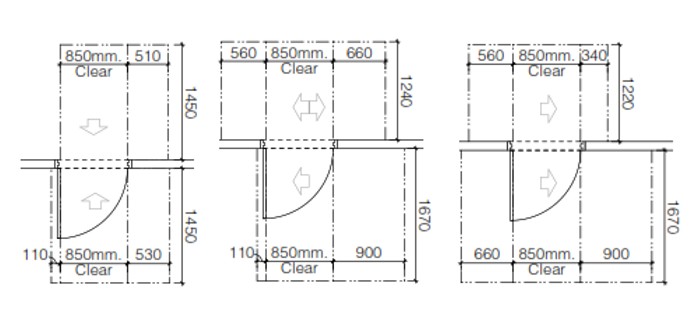
The main entry door, the adaptable bedroom door, and the adaptable bathroom door must each provide a minimum 850 mm clear opening width, with door circulation spaces designed in accordance with AS 1428.1, determined by the direction of approach.
Encroachments within the required door circulation spaces by easily removable cabinetry or by non‑structural walls (applicable to the main entry door and bedroom door) are permissible, provided that:
- these elements can be removed without structural impact, and
- post‑adaptation drawings demonstrate that full AS 1428.1‑compliant circulation spaces can be achieved after removal.
All doorways other than the main entry door, the adaptable bedroom door, and the adaptable bathroom door must each provide a minimum 820 mm clear opening width. It is considered reasonable not to provide the minimum 820 mm clear opening width to non‑adaptable bathrooms.
Some typical door circulation spaces are shown below, with arrows indicating the direction of travel.
2. Adaptable Bathroom
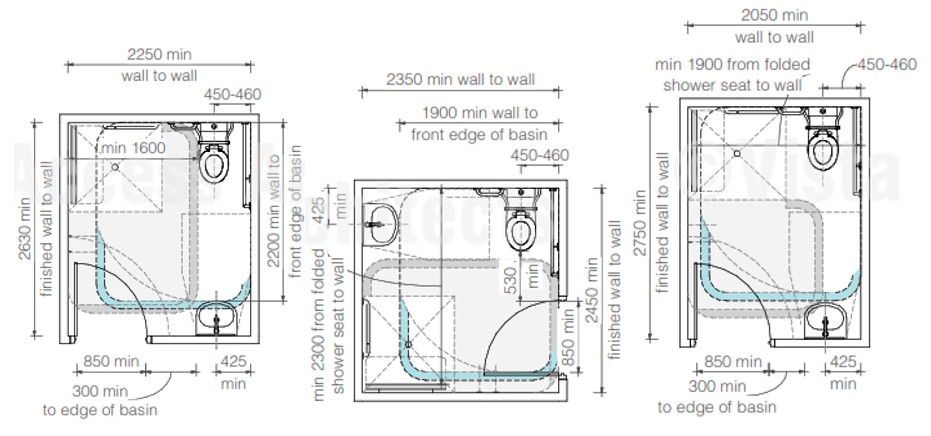
At least one bathroom within the adaptable dwelling must be capable of achieving the circulation spaces required by AS 1428.1, determined by the direction of approach to each fixture. Examples of compliant layouts are provided below.
The bathroom walls must remain in the same location in both the pre‑adaptation and post‑adaptation configurations. However, the internal layout—including the location of fixtures—may be altered between pre‑ and post‑adaptation, provided that:
- all service pipes (waste outlets and water supply points) are installed at AS 1‑compliant positions during pre‑adaptation, and
- unused services are capped for future use to enable compliant reconfiguration.
In some cases, the internal wall between two back‑to‑back bathrooms may be removed at post‑adaptation to create a single larger bathroom that meets AS 1428.1 circulation requirements.
Examples of accessible bathroom layouts are shown below. Mirror‑image configurations are also acceptable. Shower seats are not required to be provided to Adaptable dwellings at pre-adaptation.
All dimensions shown are finished dimensions. Allowances must be made for construction tolerances.
3. Laundry
The laundry must provide a minimum 1550 mm clear circulation space in front of all laundry appliances, measured as finished dimensions.
Where this clearance cannot be achieved in the pre‑adaptation layout, easily removable cabinetry may encroach into the required circulation space, provided that such cabinetry can be relocated or removed at post‑adaptation to achieve the full 1550 mm clearance.
4. Kitchen
The kitchen must be capable of achieving a minimum 1550 mm clear circulation space between opposing benchtops in the post‑adaptation layout.
While AS 4299 includes prescriptive requirements for kitchen design at pre‑adaptation, these provisions are outdated and therefore in our opinion cannot be mandated. Kitchens are typically replaced multiple times over the life of a dwelling, and therefore the pre‑adaptation kitchen layout may be contemporary and market‑appropriate, provided that the design enables full compliance at post‑adaptation.
Where the location of fixtures (e.g., sink) is required to change at post‑adaptation to achieve AS 1428.1‑compliant circulation and reach ranges, the pre‑adaptation design must ensure that:
- all service pipes (waste outlets and water supply points) are installed at AS 1428.1‑compliant positions during pre‑adaptation, and
- any unused services are capped for future use to enable compliant reconfiguration.
5. Bedroom
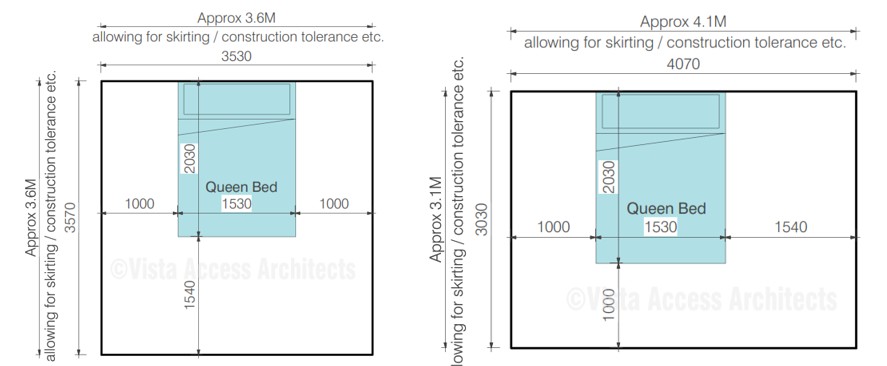
Any one bedroom within the adaptable dwelling must be capable of achieving the required circulation spaces around a Queen‑size bed in the post‑adaptation layout. The post‑adaptation configuration must demonstrate:
- 1540 mm clear circulation space on any one side of the bed, and
- 1000 mm clear circulation space on the other two sides of the bed.
These dimensions are to be shown as finished clearances, with allowances made for construction tolerances. While not ideal, it is considered acceptable for the wardrobe/robe to be located on the bedhead side of the adaptable bedroom in the post‑adaptation layout.
6. Passageways
All passageways within the adaptable dwelling must provide a minimum clear width of 1000 mm, measured from skirting to skirting at pre-adaptation. This dimension is to be demonstrated as a finished clearance, with allowances made for construction tolerances.
This does not apply to passageways within a non-adaptable bedroom.
7. Parking space allocated to adaptable dwelling
Unless a Council DCP explicitly permits a reduced number of parking spaces for adaptable dwellings, each adaptable dwelling must be allocated one (1) dedicated parking space with an accessible path of travel connecting the dwelling to their allocated parking space.
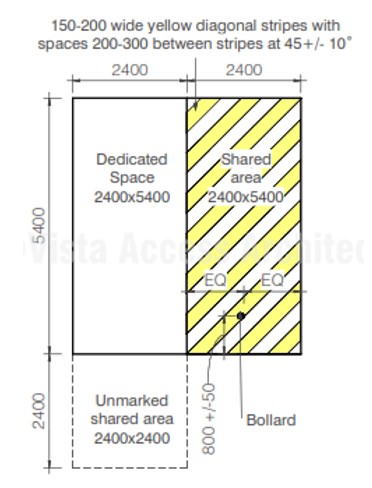
This parking space must be designed as either:
- a 3.8 m wide dedicated parking space, or
- an AS 2890.6‑2009 compliant space, comprising a 2.4 m wide parking bay plus a 2.4 m wide shared zone.
Disclaimer: The AS 4299 Adaptable Housing Standard has not been updated since 1995. Accordingly, the above requirements for designing adaptable dwellings are based on more current standards—AS 1428.1‑2021—and established industry practice. Interpretations may vary between consultants.
All drawings and associated documentation are copyrighted by Vista Access Architects. Distribution, reproduction, or use without prior written authorisation is strictly prohibited.