Livable Housing Design Guidelines (LHA) Silver level (SL) vs NCC Livable Housing Design Standards (LHDS)
An opinion piece by Farah Madon
Farah Madon is a past Director of Livable Housing Australia and also was a member of the ABCB's (Australian Building Codes Board) Livable Housing Implementation Advisory Committee. This opinion piece is based on her experience with working on both documents being discussed in this article.
Background information
The NCC LHDS were based on LHA SL, but before we get into discussion on the differences, it is important to understand who these guidelines and standards cater for.
It is to be noted that, NCC LHDS as well as LHA SL design requirements when implemented on site, DO NOT make the dwelling accessible, and the design features in these documents are NOT suitable for people with disabilities that use mobility equipment such as wheelchairs.
For example,
- The doors in NCC LHDS as well as LHA SL do not need door circulation spaces which are essential for independent use by persons requiring the use of a wheelchair for mobility.
- Both permit a shower to be provided on an upper floor with stairway access only (even though the shower itself is required to be hobless and step free).
- The only required open circulation space in front of a toilet (WC pan) is 900x1200mm which is actually smaller than a 90th percentile wheelchair footprint of 800x1300mm, so while a smaller wheelchair may possibly squeeze in, a 90th percentile wheelchair will not be able to fit in a standalone toilet, let alone a person using a wheelchair be able manoeuvre within the space to use the actual toilet pan. It is also worth noting that only 23% of users who require a wheelchair for mobility can use the frontal transfer technique to the WC pan (source AS1428.1 Supplement 1993).
- Ramps are not required to provide handrails or any other side edge protection safety features.
- and the list goes on…
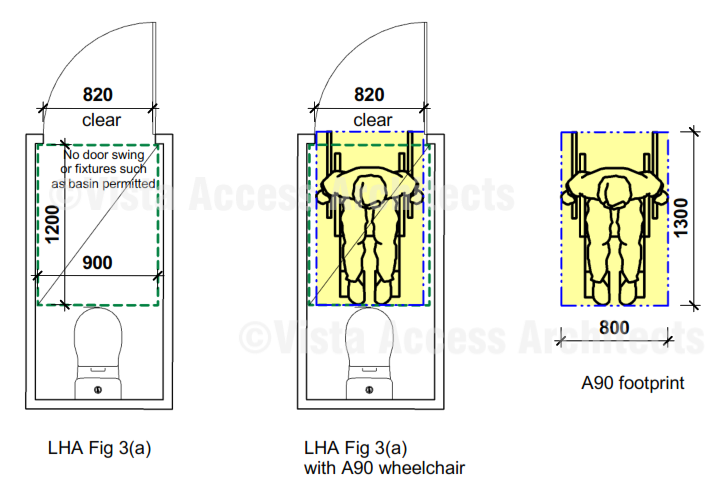
[Figures to demonstrate the space required in a standalone toilet in LHA SL/NCC LHDS as compared to the size of a wheelchair]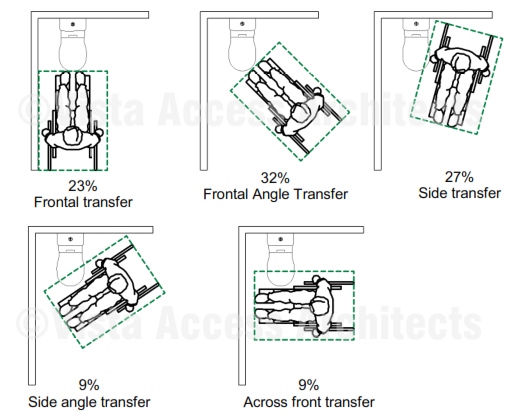
[Figures to demonstrate that only 23% of people that require use of a wheelchair for mobility use the front transfer method to the toilet pan. Source AS1428.1 Supplement 1993]
However, it is important to note that these documents are a crucial first step involving minor, cost effective, design considerations to enhance useability based on universal design principles and to enable aging in place by means of:
- slightly wider doorways
- step free door thresholds to entry level and
- some minor circulation space in front of the toilet pans, which can be used by people using walkers, with options for the provision of wall reinforcements so that grabrails can be installed in the future for one toilet, one shower and bathtub (where bathtubs are provided).
LHA has 3 different levels with Silver (SL) being the base level which is comparable to the NCC LHDS requirements, and LHA Gold being similar to the voluntary- beyond minimum standards. There is no proposed equivalent of LHA Platinum at this point in the NCC.
LHA (SL and Platinum) was used as a starting point for the NDIS (National disability Insurance Scheme) SDA (Specialist Disability Accommodation). However, notably with significant gaps and unsuitability of design features for people that require the use of mobility equipment impacting independent movement. Consequently LHA (SL and Platinum) was no longer considered to be suitable for use for NDIS SDA post the 2019 introduction of the NDIS SDA Design Standards for new SDA dwellings.
The differences between LHA Silver level and NCC LHDS are minimal as demonstrated below:
1. Dwelling Access
- Both permit access from the site boundary by means of walkways and ramps.
- Both permit alternative access via a dedicated 3200 x 5400mm size parking space, where step free pathway by means of walkways and ramps are not possible.
- For Class 2 (residential flat buildings), both defer to the NCC requirements for access from the site boundary
Conclusion: There is no substantial difference between requirements.
2. Dwelling entrance
- Both require a 820mm clear opening entry doorway
- Both require a 1200x1200 flat landing space in front (external approach side) of the main entry doorway
- Both require the main entry door threshold to be flush or be provided with a 1:8 grade doorway threshold ramp. However, the LHA permits a 56mm height doorway threshold ramp which means that the threshold ramp could be 450mm in depth. Whereas the NCC LHDS notes that the threshold ramp cannot exceed beyond the depth of the door jamb. Also, in NCC LHDS where there are valid specific weatherproofing concerns, a lip of max 15mm is permitted within the sill profile as well as a max 5mm between the top surface of the sill and adjoining finished surface.
- Both require a roof covering for the main entry door and while LHA does not specify a minimum size of cover noting ‘reasonable shelter from weather’, the NCC LHDS requires a minimum of 1200x1200 roof cover.
Conclusion: In most cases the NCC LHDS provides better outcomes by means of lower door thresholds (based on the thickness of the door jamb) and also specifies a minimum roof covering as compared to the LHA.
3. Internal doors and corridors
- Both require a minimum 820mm clear door opening to the doorways on the entry level. In addition, where the shower is not on the entry level, the clear door opening size is not mandated in the LHA, however this is mandated to be a minimum of 820mm clear opening in the NCC LHDG.
- While the LHA requires a level transition to the habitable rooms on the entry level, the NCC LHDS permits a door threshold ramp on the condition it is fully within the depth of the door jamb.
- A minimum 1000mm corridor width for the LHA is measured from the narrowest section i.e. skirting to skirting, whereas in the NCC LHDS it is measured from wall to wall.
Conclusion: While it could be argued that the requires a higher level of amenity to the internal door thresholds on the entry level by means of a flush door threshold, it is important to note that doorway threshold ramps are still permissible even for people that require the use of a wheelchair for mobility under AS1428.1. So, the validity for the sole requirement of flush door threshold could be questioned as the functionality is still maintained via the threshold ramp.
Also, since the full width of the door threshold ramp is to be within the door frame, and the grade specified is a maximum of 1:8, the level difference when using a 90mm wide door jamb would be under 12mm and consequently functionality and objectives are still met.
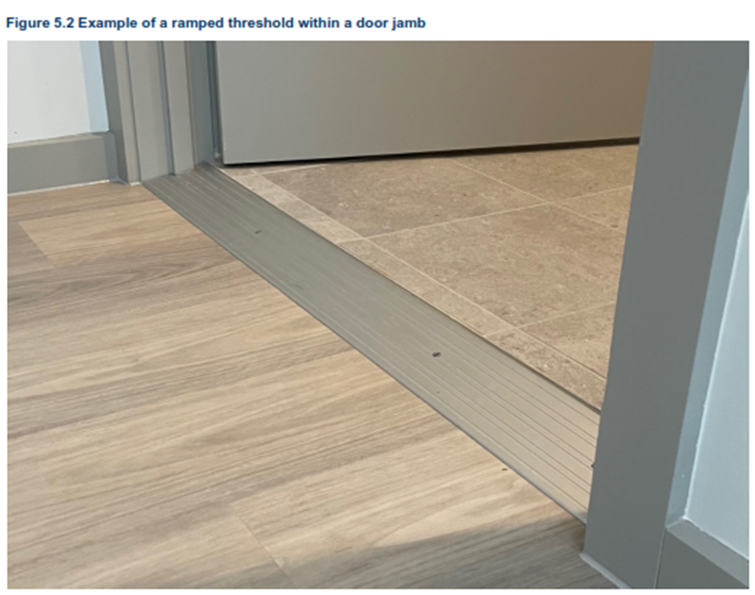
[Above image is from the ABCB LHD Handbook, demonstrating the full threshold ramp within the door frame]
4. Sanitary compartment
- Both require a minimum 900x1200mm clear space in front of the WC pan,
- The LHA mandates that the toilet pan needs to be in the corner of the bathroom, whereas the NCC LHDS does not mandate this requirement consequently providing more design flexibility.
Conclusion: The NCC LHDS allows for more flexibility in design of bathrooms as compared to the LHA
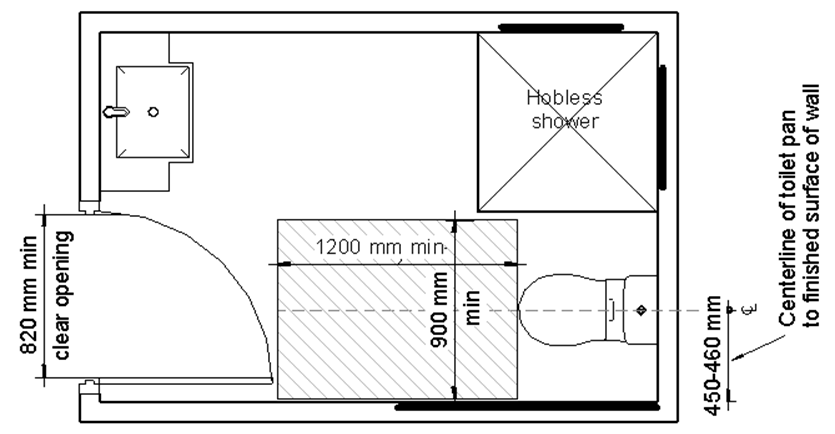
[Sample of LHA SL bathroom]
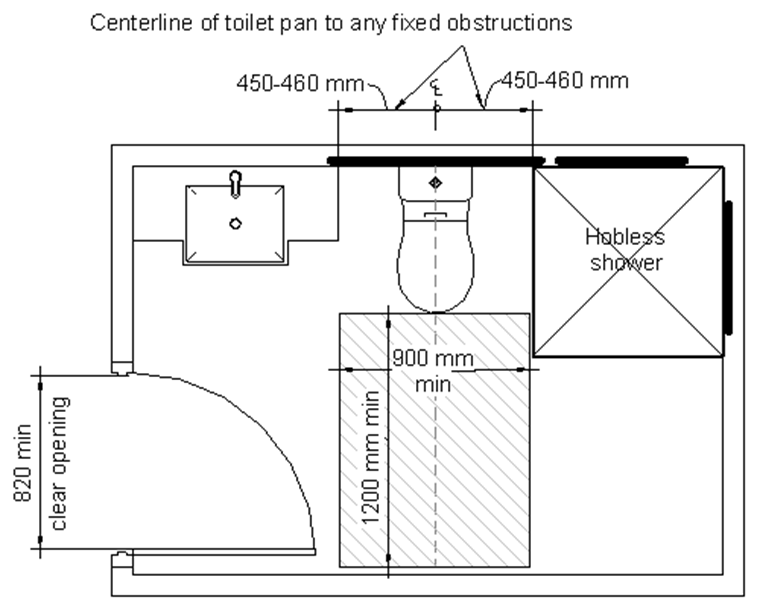
[Sample of NCC LHDS bathroom]
5. Shower
- Both LHA and NCC LHDS require one hobless shower and both do not mandate locating the shower on the entry level.
Conclusion: There is no substantial difference between requirements.
6. Reinforcement of bathroom and sanitary compartment walls
- LHA and NCC LHDG have the same requirements for sheeting and nogging for shower.
- LHA and NCC LHDG have the same requirements for sheeting and nogging for bathtubs, however, the NCC LHDS permits the non-provision of wall reinforcements for free standing bathtubs.
- NCC LHDS permits a 600mm wide sheeting in lieu of 1000mm wide sheeting to side wall of the WC pan wall. Where the WC pan is not located on the corner wall, the NCC LHDS also permits nogging to the back wall to allow for drop down grabrails. Side wall nogging that is permitted in the LHA is not permitted in the NCC LHDS.
Conclusion: The LHA nogging option for the WC pan can only be used by a specific grabrail. The NCC LHDS provides better outcomes than the LHA by wall reinforcement that is suitable for use by multiple grabrail designs including dropdown style grabrails (similar to the NCC Adult change facilities) which are one of the most common home modifications for aging in place.
The NCC LHDS allows for more flexibility in design of bathrooms as compared to LHA.
7. Internal Stairways
- LHA requires a continuous handrail on one side of the stairway. The NCC already has requirements for a handrail to one side of the stairway for stairways more than 1M in height and therefore this section on stairway balustrade is not replicated in the NCC LHDS so as not to cause conflict with other NCC requirements.
Conclusion: In this case the LHA has a slightly higher level of amenity by requiring a handrail regardless of the height of the rise of the stairway. However, unless the design is a split-level dwelling (i.e. not a full flight of internal steps leading to an upper floor level), the handrail requirements under both LHA and NCC LHDS remain the same.
Application
At this point, the Livable Housing Design Guidelines are still followed in NSW by some government organisations. This is potentially since the NSW government has opted out of mandating NCC Livable Housing Design Standards. This however is creating confusion in the market with 2 sets of ‘Livable Housing’ documents for developers to choose from who like to introduce Livable Housing Design features in their dwellings, especially in NSW.
I would suggest that where the option exists, choosing the NCC Livable Housing Design Standards over the older Livable Housing Design Guidelines is now the practical and future focused approach for any organisation.
The Livable Housing Design Guidelines can no longer be updated (last updated in 2017) given the fact that Livable Housing Australia as a company has been deregistered (source ASIC), which means the current guidelines cannot keep pace with contemporary construction techniques, regulatory alignment or industry practice.
In contrast, the NCC Livable Housing Design Standards have been formally adopted into the Building Code of Australia, giving them legal weight, national consistency and ongoing development through the Australian Building Codes Board.
This ensures that projects designed to the NCC Livable Housing Design Standards are aligned with current policy directions, contemporary evidence and the broader shift toward universal design in mainstream housing.
The NCC Livable Housing Design Standards provide clearer technical provisions, stronger compliance pathways and a more reliable foundation for long term universal design outcomes. Because they are embedded within the regulatory framework, they remove the uncertainty that comes with relying on a guideline that is no longer maintained and not referenced in the NCC.
Implementing the NCC Livable Housing Design Standards instead of the Livable Housing Design Guidelines therefore reduces risk, supports consistent certification processes and ensures that new dwellings are designed to meet the needs of basic universal design features. This positions the NCC Livable Housing Design Standards as the more relevant, robust and responsible choice for any project seeking to deliver meaningful universal design in residential dwellings.
Disclaimer:
This is an opinion piece by Farah Madon and in her own capacity and does not reflect the opinions of any organisations, committees or boards that she is associated with.
Copyright:
The images in this article are copyright of Vista Access Architects and unauthorised use will be considered to be an infringement of copyright laws.